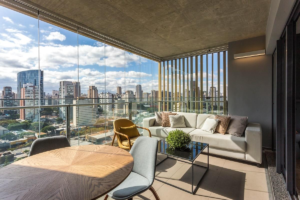
São Paulo has one of the largest and most liquid residential property markets in Brazil. Prices have risen steadily in recent years, new developments continue to enter the market and demand remains strong.
But there is a question international investors should be asking:
Is São Paulo’s property market becoming a bubble?
The answer is more nuanced than the headline numbers suggest.
Prices are rising — but not at an extreme pace
According to the May 2026 FipeZAP index, residential property prices in São Paulo averaged R$9,809 per m², up 4.23% over the previous 12 months. That was below the broader FipeZAP market increase of 5.59%. (downloads.fipe.org.br)
At the same time, rents have been moving faster.
Residential rents in São Paulo increased 5.87% over 12 months, reaching an average of R$64.67 per m² in May 2026. The city’s average rental yield stood at approximately 6.40% annually. (downloads.fipe.org.br)
That is an important distinction.
A market where property prices are rising rapidly while rents stagnate can raise concerns about speculative pricing. São Paulo currently shows a more balanced picture: rental growth is supporting property values rather than simply following them upward.
The market is still highly active
The new-build market tells another part of the story.
In 2025, developers launched 139,700 residential units in São Paulo, a 34% increase compared with 2024. Sales reached approximately 113,000 units, up 9%. The total value of new launches rose 40% to R$81.7 billion. (SECOVI-SP)
And the momentum continued into 2026.
Between June 2025 and May 2026, approximately 114,800 new residential units were sold, generating R$60.2 billion in sales value. The city had around 88,800 units available for sale at the end of May. (SECOVI-SP)
On the surface, that looks like an extremely strong market.
But there is an important caveat.
Not all of São Paulo is booming
A significant share of the recent activity has been driven by Brazil’s Minha Casa Minha Vida affordable housing programme.
In May 2026, 70% of new units launched and 71% of units sold in São Paulo fell within the programme. The strongest demand was concentrated in smaller apartments, particularly units between 30 and 45 m². (SECOVI-SP)
The picture is very different in the middle and upper segments.
Higher interest rates have made financing more expensive, while the supply of new developments has increased. This has contributed to higher inventories in parts of the market outside the affordable segment. (UOL Economia)
For international buyers, this distinction matters.
The headline figure of 113,000 sales does not mean that every segment of São Paulo’s property market is equally strong.
So, is there a bubble?
We don’t think the data currently points to a broad São Paulo property bubble.
Price appreciation is relatively moderate. Rental values are still increasing. Transaction volumes remain high, and the market has a deep underlying demand base.
But that does not mean every property is fairly priced.
The greater risk may be micro-market overvaluation rather than a city-wide bubble.
Prime neighbourhoods can command very high prices, while newly launched developments may carry significant premiums compared with comparable resale properties.
At the same time, some areas have strong rental demand and limited supply, while others are experiencing substantial new construction.
For investors, the question therefore becomes less:
“Is São Paulo in a bubble?”
and more:
“Which parts of São Paulo are correctly priced relative to their fundamentals?”
What international buyers should look at
For an international buyer, we would focus on several indicators before considering a property:
Price per m²
How does the asking price compare with comparable properties in the same neighbourhood?
Rental yield
Does the expected rental income justify the acquisition price?
Supply pipeline
How many new developments are coming to the same area?
Liquidity
How easily could the property be resold?
Neighbourhood fundamentals
Employment, transport, services, restaurants, universities and infrastructure can all influence long-term demand.
Property-specific factors
Floor, view, orientation, building quality, condominium costs and parking can have a substantial impact on value.
The opportunity may be in the details
São Paulo is too large and too diverse to treat as a single property market.
The city has neighbourhoods where prices have already moved significantly, alongside areas where rental demand, infrastructure and development activity may still provide room for further growth.
That creates a more interesting investment environment than simply chasing the markets with the highest recent price appreciation.
Our view: São Paulo does not currently look like a broad property bubble. But it is increasingly a market where selectivity matters more than market direction.
For international buyers, understanding the difference between an expensive property and a genuinely valuable property may be more important than predicting where São Paulo’s overall price index will move next.